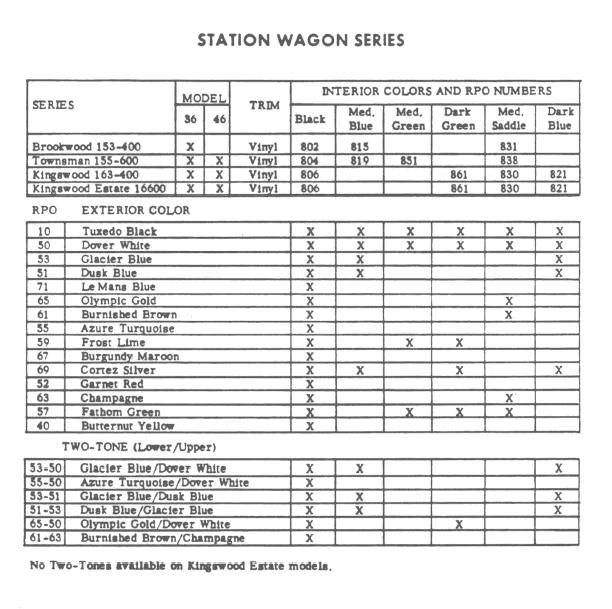
Decoding
Your trim (body) tag
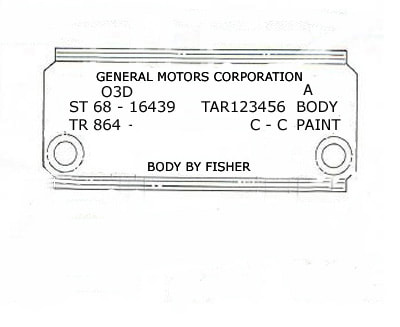
The trim tag (or cowl tag) is the next important tag on your vehicle after the VIN. There essentially 2 styles of trim tags found on 1969 full size Chevrolets, that used in previous production years up to and including early 1969, and that used for late 1969. Canadian and American built Chevrolets used variations of these two styles. Examples may be seen below:
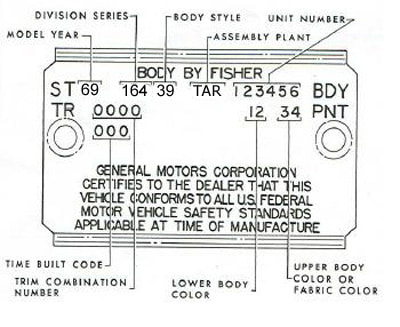
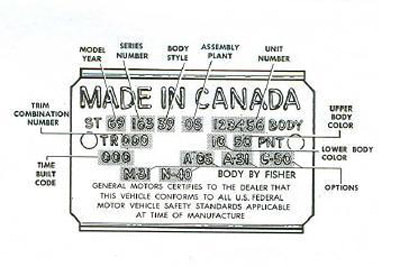
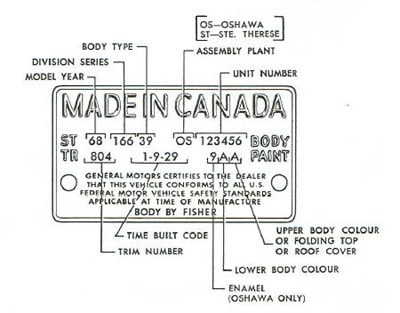
|
Late 1969 American Trim Tags
This is the most common trim tag style found on 1969 full size Chevrolets. It is the late 1969 style. Not shown on this diagram are option codes, found on the bottom line of the tag. There is no formal information available on how to decode option codes, however many clubs and web sites have attempted to do so. The only thing known for sure about these codes is that they indicate options that required modification of the body in the Fisher Body plant prior to final assembly. Option codes are not always present on trim tags. As we have no way to validate the meanings of the codes, we will not attempt to decipher them. Late 1969 Canadian Trim Tags
This is the Canadian version of the late 1969 style trim tag. Notice on this diagram the option codes do appear. The option codes did not necessarily correlate to any RPO Regular Production Option) codes as you will see in the early 1969 American example. The numbers on the bottom line and their meaning varied from plant to plant in many cases. Early 1969 Canadian Trim Tags
Here is an example of an early 1969 Canadian trim tag. This example actually shows a 1968 car however this was the style used into the 1969 model year. Differences of note include the time built code location, and style (not a 3 digit alpha-numeric code as with the other examples). This tag also indicates not just the paint code but the type of paint, unlike the others. Option codes are not present on this example, however just like the late 1969 tags they appeared on the bottom line if they were present. Option codes were not always indicated on the tags. Early 1969 American Trim Tags
This is an example of the early 1969 American trim tag (although it shows a 1968 Chevrolet in this example). Differences from the Canadian one are the location of the time built code on the top line, the option codes on the bottom line, and the "A" code also on the top line. This code was used on the assembly line to quickly identify a specific interior, however different codes were used from plant to plant, and some plants didn't use them at all. It is impossible to know the exact meaning of this code. |
Decoding your trim tag is easy if you have all the information you need. Fortunately, we're going to provide that information for you here.
Listed below is each position on the trim tag and how to interpret it.
Model Year
Very simple, it will appear as "69" for all 1969 Chevrolets
Series Number or Division Series
Regardless of the series, this 3 digit code will always start with a "1" indicating Chevrolet Motor Division. The next two digits indicate if it is an Impala, Caprice, Bel Air, or Biscayne, but unlike the VIN they DO NOT indicate if it has 6 or 8 cylinders. This is because Fisher Body did not follow exactly the same system as the Chevrolet VIN. For example, if your VIN indicates you have a 6 cylinder car, let's say the first 3 digits are 155, the trim tag will read 156, and will not reflect that information. This is why some cars with 6 cylinder VINs may appear to have 8 cylinders by the trim tag.
154 = Biscayne
156 = Bel Air
164 = Impala
166 = Caprice
Body Style or Body Type
These two digits indicate the body style as per the chart below:
11 = 2-door sedan, 6 passenger
36 = 4-door station wagon, 6 passenger
37 = 2-door sport coupe, 5 passenger
39 = 4-door sport sedan, 6 passenger
46 = 4-door station wagon, 9 passenger
47 = 2-door custom coupe, 5 passenger
67 = 2-door convertible, 5 passenger
69 = 4-door sedan, 6 passenger
Assembly Plant
The assembly plant is determined by a 2 or 3 digit code. The chart below shows codes only for assembly plants where full size Chevrolets were produced.
BC = Southgate, California
BA = Atlanta, Georgia (Doraville)
FL1 = Flint, Michigan
FL2 = Flint, Michigan
JAN = Janesville, Wisconsin
LOS = Los Angeles, California
BT = Arlington, Texas
STL = St. Louis, Missouri
TAR = Tarrytown, New York
LOR = Lordstown, Ohio
BW = Wilmington, Delaware
OS = Oshawa, Ontario
ST = St. Therese, Quebec
Unit Number
This is a unique number assigned to each car by the factory it came from. It is the sequential build number for the body, but has no correlation whatsoever to the VIN or any other number, nor does it relate to the vehicle assembly unit number in the VIN.
Time Built Code
The time built code on most tags is a 3 digit alpha numeric code consisting of two numbers and a letter. The first two numbers indicate the month the car was built, while the letter represents the week. See below:
01 = January
02 = February
03 = March
04 = April
05 = May
06 = June
07 = July
08 = August
09 = September
10 = October
11 = November
12 = December
A = First Week
B = Second Week
C = Third Week
D = Fourth Week
E = Fifth Week
Therefore, a time built code of "03D" would equal 4th week of March, 1969.
Some Canadian built cars have a different system on early 1969 tags. They consist of three hyphenated numbers. At this time we do not have an exact reference to understand these codes, but will list it here once available.